Battle of Los Angeles
Case Summary
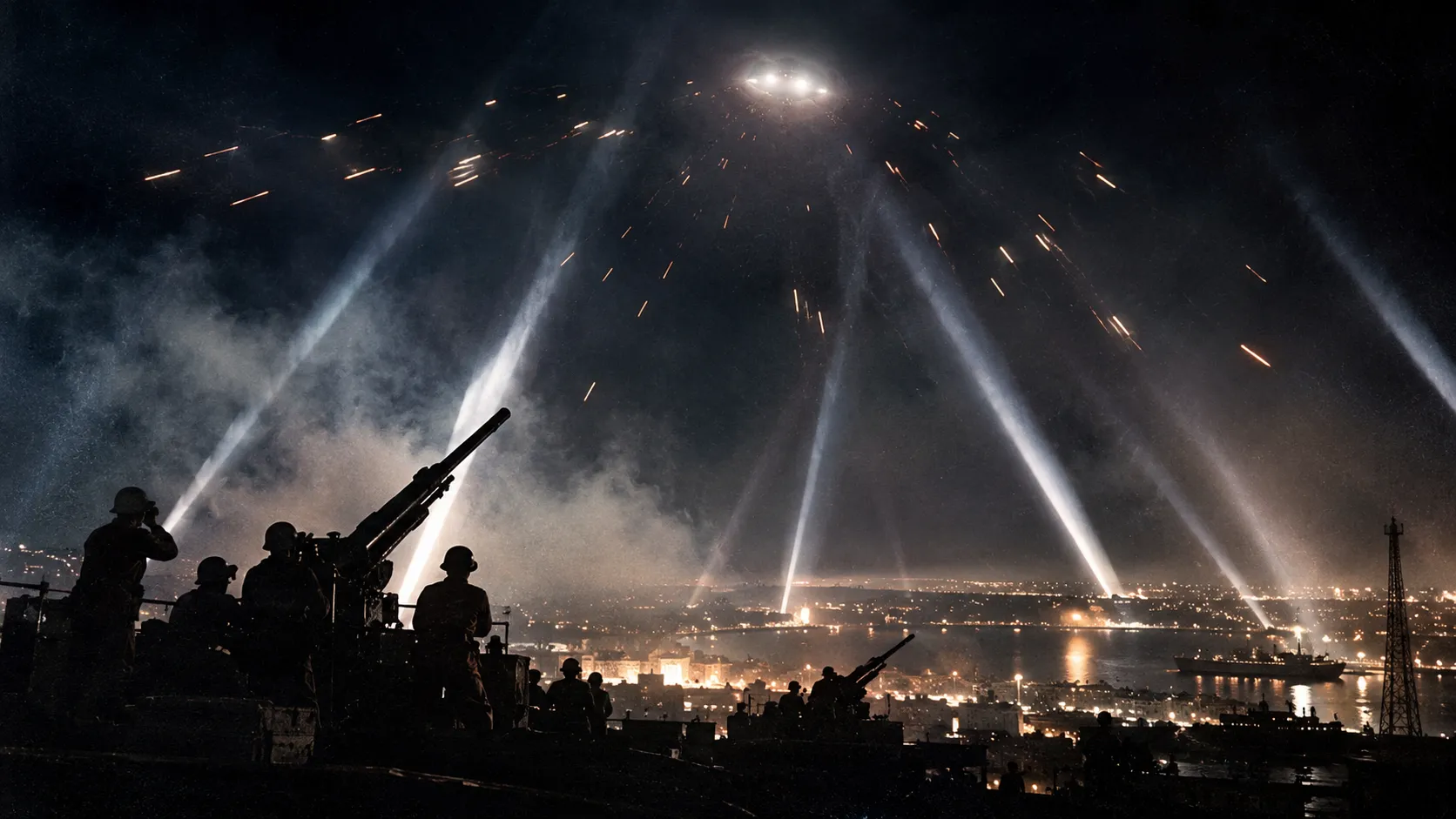
During the early hours of February 25, 1942, air-raid warnings and reports of unidentified aircraft over Los Angeles triggered a major anti-aircraft response. Searchlights swept the sky while military batteries fired approximately 1,400 rounds at reported aerial targets during a blackout. No confirmed enemy aircraft were established as the cause of the barrage, and no hostile aircraft were reported shot down. Contemporary military assessments disagreed over what had been observed, while later official histories attributed the confusion to meteorological balloons and misidentified visual targets. The event became known as the Battle of Los Angeles and remains a frequently discussed historical UFO case, although the available evidence does not establish that an extraterrestrial craft was present.
Overview
The Battle of Los Angeles, also known as the Great Los Angeles Air Raid, occurred during the early hours of February 25, 1942, less than three months after the Japanese attack on Pearl Harbor. Southern California was on heightened alert amid fears of a possible Japanese attack on the American mainland. On February 23, a Japanese submarine had shelled oil installations near Ellwood, north of Santa Barbara, intensifying concerns about an attack on the West Coast.
At approximately 2:25 a.m. on February 25, air-raid warnings were issued in the Los Angeles area after reports of approaching hostile aircraft. Searchlights illuminated the night sky, blackout measures were enforced, and anti-aircraft batteries opened fire at reported aerial targets. The barrage continued for approximately an hour, with historical accounts commonly citing about 1,400 rounds of anti-aircraft ammunition. The Los Angeles Times reported that 1,433 rounds were fired during the episode.
The event produced a dramatic scene over the city, with searchlight beams crossing the sky and explosions from anti-aircraft shells illuminating the darkness. Residents reported seeing objects or formations in the illuminated areas, but the descriptions were inconsistent. Some observers believed that aircraft were present, while others described balloons or poorly defined objects. The heavy smoke, shell bursts, intersecting searchlights, darkness, and wartime anxiety complicated visual identification.
No confirmed enemy aircraft were shot down, and no bomb damage attributable to an aerial attack was established. Falling anti-aircraft ammunition caused scattered property damage, and five deaths were reported in later accounts, including three associated with automobile accidents during the blackout and two attributed to heart attacks. The event nevertheless generated immediate controversy because the military response was extensive while the identity of the targets remained uncertain.
The official explanations were not entirely consistent. Secretary of the Navy Frank Knox described the incident as a false alarm, while Secretary of War Henry Stimson subsequently discussed the possibility that aircraft had been present, including a claim that commercial aircraft flown by enemy agents might have crossed the area. These public statements reflected the uncertainty and political pressure surrounding the event rather than a definitive identification of an object.
A major historical source is The Army Air Forces in World War II: Plans and Early Operations, Volume 1, published under the Office of Air Force History. The account describes the conflicting reports collected after the barrage and concludes that meteorological balloons were responsible. The Army's interpretation also considered the possibility that shell bursts illuminated by searchlights had been mistaken for aircraft. A separate assessment by Army Colonel John G. Murphy, who witnessed the incident and participated in the subsequent investigation, was published in the Antiaircraft Journal in June 1949 and likewise attributed the sightings to meteorological balloons.
The famous photograph associated with the Battle of Los Angeles shows searchlights converging over the city during the barrage. It has often been reproduced as an image of an unidentified object under fire. However, a later Los Angeles Times archival investigation found that the widely circulated newspaper version had been retouched, including modifications to the searchlight beams. The photograph is therefore important historical documentation of the event, but it cannot independently establish the appearance or identity of a target in the sky.
The incident was reported extensively in contemporary newspapers, including the Los Angeles Times on February 26, 1942. Later research has examined military records, wartime newspaper coverage, photographs, and witness accounts. Some modern UFO interpretations argue that the barrage may have been directed at an unidentified craft, but the historical record does not establish that conclusion. The available sources document the military response and the confusion surrounding the observations, rather than confirming an extraordinary aerial vehicle.
The Battle of Los Angeles is best understood as a historically documented air-defence incident whose aerial targets were not conclusively identified in the contemporary record. Conventional explanations involving meteorological balloons, shell bursts, searchlights, and wartime misidentification are supported by official historical accounts. Although the event remains significant in UFO history, no independently verified physical evidence establishes that an extraterrestrial or technologically anomalous craft was present. The case is therefore classified as disputed, with the military response well documented but the identity of the reported targets unresolved.
Case Information
| Date: | 1942-02-25 |
| Location: | Los Angeles, California, United States |
| Country: | United States |
| Category: | Military |
| Credibility: | Disputed |